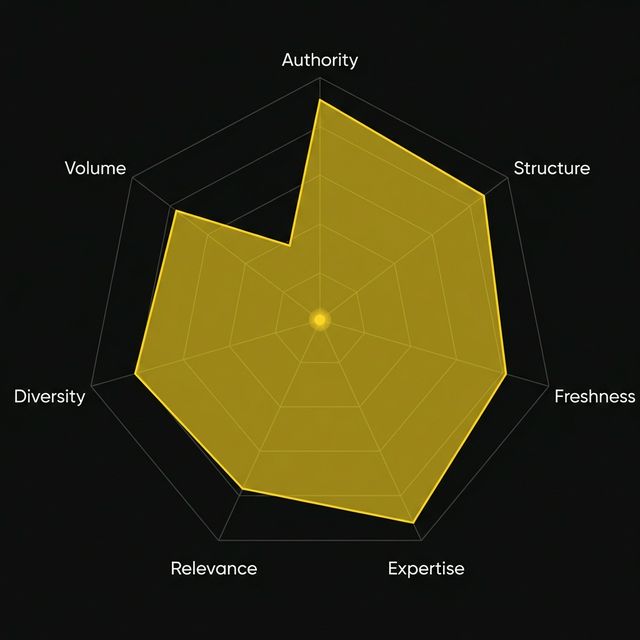
AI citation visibility can be measured with fixed prompt sets, source capture, and repeat reviews. The pages worth prioritizing are not always the longest pages, but the clearest, most verifiable, and most useful source candidates. That review habit separates mentions, citations, referrals, and actual demand.
The 7 Signals That Drive AI Citations
1) Definition Clarity in the Opening
Pages with a precise definition in the first paragraph are easier for models to extract and reuse. In practice, definition-first pages are easier to evaluate than pages that open with long scene-setting intros.
2) Evidence Density (Numbers + Attribution)
The GEO paper reports that tested optimization strategies can increase AI visibility by up to 40% in generative engine responses. For client or internal benchmarks, avoid repeating exact citation-lift numbers unless the page can show the method, sample, date range, and approval to publish.
3) Structured Extractability
Headings, concise paragraphs, bullet lists, and comparison blocks improve extractability. AI systems prefer answer-ready blocks over long narrative walls of text.
4) Framework Naming
Named methods are easier to cite than vague recommendations. A page that describes a staged GEO framework with concrete steps is more useful than one that only says "improve your strategy over time."
5) Topical Context and Internal Graph
Isolated pages are harder to evaluate. Citation-readiness improves when pages are connected to related assets like foundational GEO definitions and AI search behavior analysis.
6) Entity Consistency
When brand description, author identity, and service positioning are consistent across pages and external profiles, source trust improves. Inconsistent entity language reduces confidence in retrieval pipelines.
7) Original Perspective / Information Gain
Pages that add implementation detail, approved benchmarks, or real constraints are stronger source candidates than pages that restate consensus. This is the strongest separator in crowded topics.
Statement-only content is easy to generate and easy to ignore. Evidence + method + experience is what gets cited.
Citation Readiness Matrix
A citation readiness matrix translates the seven signals into a practical review model. Score each high-value page before rewriting it. The goal is not to make every page longer; the goal is to make the page easier to verify, quote, and connect to the rest of the site's entity graph.
| Signal | Low Readiness | High Readiness |
|---|---|---|
| Definition | Opening paragraph delays the answer or uses vague category language. | First 80-120 words define the topic, audience, and use case clearly. |
| Evidence | Claims have no source, date, scope, or method. | Important claims include attribution, date, and the business implication. |
| Structure | Long blocks of text with few headings, tables, or checklists. | Answer-ready sections, comparison tables, and concise next steps. |
| Context | Page is isolated from related entities and supporting topics. | Links connect to topical authority, service pages, and relevant proof pages. |
| Trust | No author, no review date, no editorial policy, no original experience. | Author identity, review date, sources, and E-E-A-T signals are visible. |
Citation-Worthy Page Blocks
Citation-worthy page blocks are the pieces an answer engine can reuse without guessing context. Add them near the claim they support. A strong GEO page normally needs several of these blocks, especially when the topic is competitive or commercially valuable.
- Definition block: a concise explanation with the category, audience, and use case.
- Comparison block: a table that distinguishes two similar concepts, such as SEO versus GEO or AI Overviews versus classic snippets.
- Evidence block: one sourced statistic with date, scope, and implication.
- Method block: a named process with ordered steps that a team can follow.
- Experience block: a real observation from delivery, supported by constraints and measured outcome.
- Decision block: a short checklist that tells the reader what to do next.
These blocks support the broader GEO framework because they make content useful to humans while also giving AI systems clear source candidates.
Experience Block: What Changed in Real Page Rewrites
In internal reviews, pages with clearer source attribution, comparison blocks, and explicit methodology steps were easier to evaluate and prioritize for citation-readiness work. When exact client metrics are not approved for publication, keep the lesson qualitative and tie any proof to a named case page.
A practical reference point is our GEO citation case, where structure and evidence improvements are documented as the implementation pattern.
Implementation Checklist
- Answer the primary query in the first 2-3 sentences.
- Add source attribution for every important number in the body.
- Name a framework and list its stages.
- Link to supporting articles and one relevant case page.
- Connect to commercial pages like AI Search service and SEO service.
Common Mistakes
Common mistakes usually come from treating AI citation work as a copywriting pass. Citation systems need confidence. If the page is generic, unsourced, or disconnected from a trustworthy site structure, it may be summarized but not cited.
| Mistake | Why It Hurts | Better Fix |
|---|---|---|
| Adding unsupported statistics | Models and readers cannot verify the claim. | Use primary sources or mark internal benchmarks clearly. |
| Publishing one isolated "AI SEO" post | The site lacks topical depth around related questions. | Build a cluster with definitions, signals, examples, and service proof. |
| Hiding expertise in the footer | Author and editorial context are hard to detect. | Show author, review date, editorial policy, and relevant case context near the article. |
| Optimizing only for one platform | AI systems vary by retrieval model and prompt type. | Measure several answer engines and track citation share over time. |
FAQ
Do citations require very high domain authority?
Authority helps, but format and information gain often decide inclusion for long-tail and specialized topics.
How many pages should we optimize first?
Start with the highest-intent or highest-impression pages, then scale the same pattern across the cluster.
Can one article rank and be cited if it is short?
It can, but durable citation performance usually requires deeper coverage and stronger cross-page context.
Next Step
If you want systematic citation growth, combine page rewrites with monitoring and entity cleanup through our GEO service and execution support from content operations.