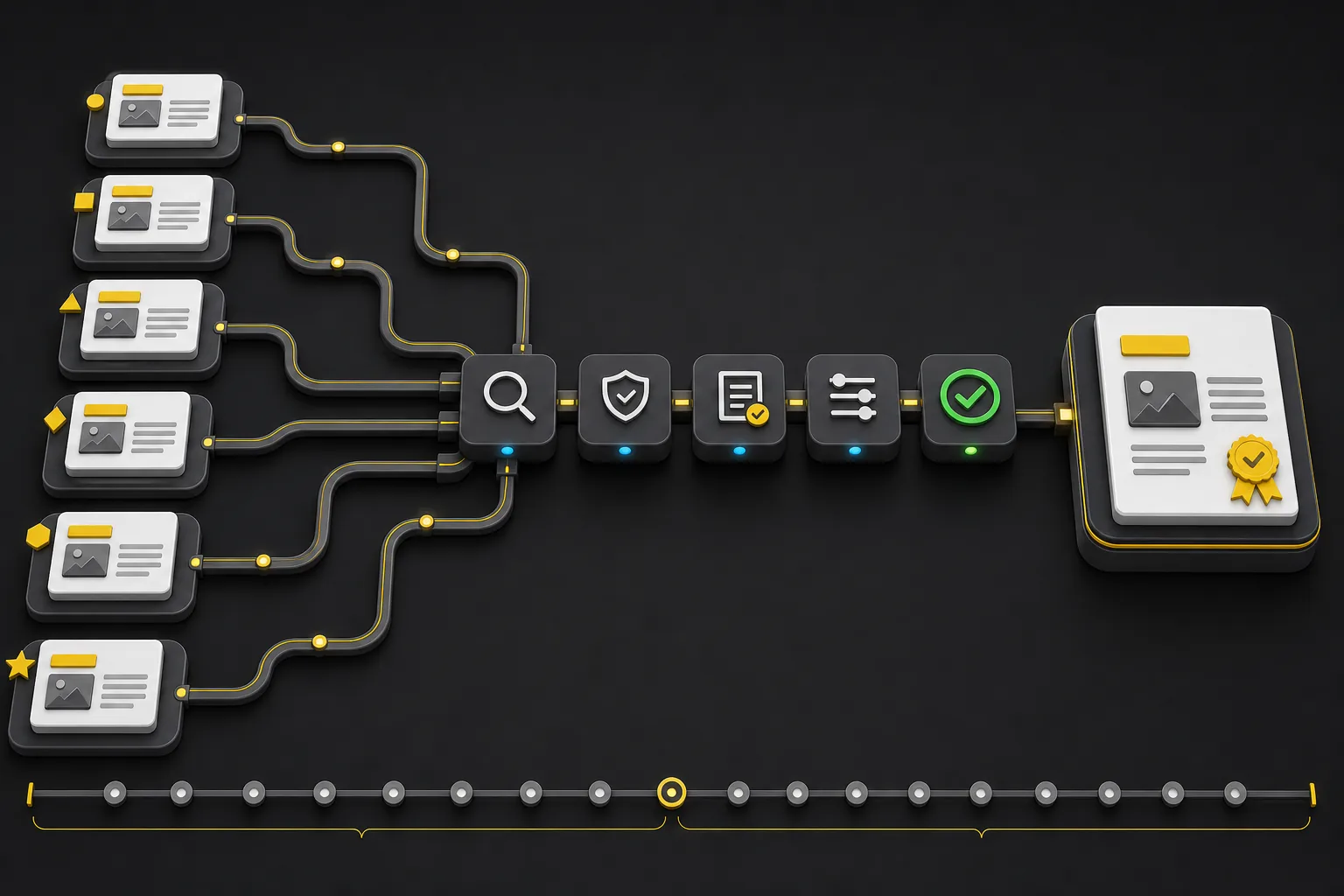
A canonical fix can be correct and still look unchanged in Google for days. That delay often triggers another edit or rollback before the first change is evaluated.
Google added useful timing context on July 10, 2026. Its canonicalization troubleshooting guide now says that, after content issues are fixed, Google might keep pages in a duplicate cluster for up to two weeks. This is not a promise that every canonical change completes on day 14. It is a practical warning that a stable implementation needs an observation window.
The practical question is whether the team defined the duplicate cluster, aligned its signals, and collected enough evidence to distinguish processing time from a conflict. This workflow complements a broader technical SEO audit checklist.
What Google's two-week guidance does and does not mean
Google's update log says the troubleshooting guide was changed to clarify re-evaluation time. The guide now explains that pages may remain in a duplicate cluster for up to two weeks after content issues are fixed. It also says that pages generally split out faster when the difference between them is clear and significant.
Three boundaries matter:
- It is an upper observation window, not an SLA. Google says "might" and "up to," so do not promise a completion date to a client or stakeholder.
- It concerns duplicate clustering after content fixes. A broken redirect or contradictory canonical is not made correct by waiting.
- Re-evaluation is not ranking recovery. Canonical selection is one technical dependency, not a visibility guarantee.
Hold a clean implementation steady while monitoring it, but do not ignore contradictory evidence.
Define the URL cluster before changing code
A canonical is a preference within a group of duplicate or very similar URLs. Start by writing down that group. A product cluster might include the clean URL, tracking and sort parameters, a legacy path, and a rendered variant. Similar regional pages may instead need to remain independent.
Record:
- The preferred canonical and duplicate URL patterns.
- Status and redirect target for each pattern.
- Canonicals in source and rendered HTML.
- Sitemap and internal-link destinations.
- The user purpose and a Search Console sample for each variant.
This prevents distinct pages from being collapsed because their templates are similar. Google notes that significant content differences can help pages split from a cluster. URLs needing independent visibility require independently useful primary content.
Align every canonical signal around one URL
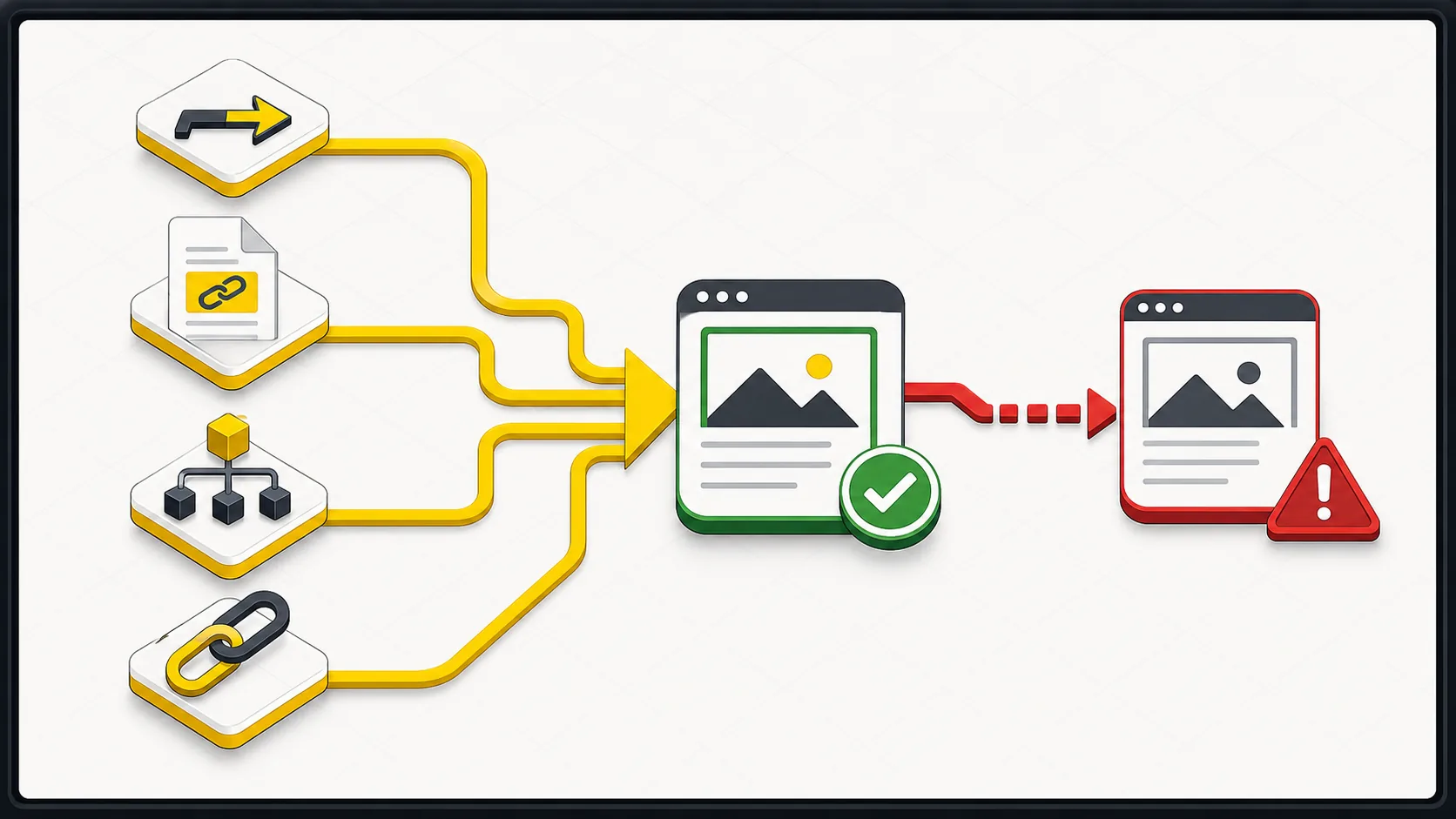
Google documents redirects and rel="canonical" annotations as strong canonical signals, while sitemap inclusion is weaker. It also says these methods can reinforce one another. The operational lesson is straightforward: use fewer contradictions, not more tags.
For each cluster, check that:
- permanent redirects and accessible duplicates point to the preferred URL;
- the preferred page is self-canonical;
- sitemaps and internal links use preferred URLs;
- JavaScript does not replace the source canonical; and
hreflang, alternates, and pagination do not imply a different cluster.
Read the diagram below as a convergence test. When redirects, HTML, sitemaps, and internal links point toward one destination, the cluster is easier to explain and maintain. A branch pointing elsewhere is an investigation item.
Google advises against different targets across techniques and recommends internal links to the canonical URL. Keep the canonical clear in source HTML and unchanged by JavaScript.
If the old URL has permanently moved, use a permanent server-side redirect where possible. Google describes permanent redirects as a canonical signal for the target. Temporary redirects behave differently: Google follows them, but its indexing pipeline does not use them as the same signal that the target should become canonical.
Decide whether to wait, investigate, or roll back
| Observed evidence | Decision | Next check |
|---|---|---|
| Recent release, signals aligned, no live defect | Wait and monitor | Review the same URL cohort at the next checkpoint. |
| Unexpected selection plus a conflicting signal | Investigate | Fix the conflict, verify production, and restart the observation window. |
| Redirect loop, wrong template target, or user impact | Roll back | Restore the last known safe behavior, then diagnose offline. |
| Distinct page remains clustered with a near-duplicate | Investigate content distinction | Confirm independent intent and strengthen primary content differences. |
The decision module below separates normal processing from conditions that deserve immediate engineering work.
Wait when the release is recent, the page is crawlable, signals agree, and sampled URLs show no new failure. Investigate visible conflicts, weak content distinction, sitemap drift, or unstable rendering. Roll back when a release harms users, creates loops, or points whole templates at the wrong target.
Do not wait for a known defect or keep editing a coherent cluster because the indexed view lags production.
A controlled canonical release workflow
Run canonical changes like a release, not a metadata cleanup.
- Capture the baseline. Export affected patterns, statuses, canonical targets, sitemap membership, internal links, and Google-selected canonicals for a sample.
- State the outcome. Name the preferred URL and whether duplicates should redirect, remain accessible with a canonical, or stay independent.
- Test outside production. Compare source and rendered HTML; check chains, absolute URLs, statuses, and staging domains.
- Release a bounded cohort. Start with one template or URL family and avoid unrelated SEO changes.
- Verify production. Re-crawl the cohort and confirm that headers, HTML, sitemaps, and links use the intended target.
- Request indexing selectively. Google says the feature is quota-limited, so use a small diagnostic sample.
- Hold steady. Record deployment and review checkpoints before another speculative change.
- Compare evidence. Review URL Inspection, crawl output, logs where available, and landing-page behavior for the cohort.
URL Inspection shows Google's selected canonical for the indexed version. Inspect the preferred URL and one duplicate, then compare with the live crawl.
For migrations, use the same discipline in traffic recovery after migration. Canonicals support the architecture; they do not replace redirects or verified mappings.
Example: faceted ecommerce URLs
Consider a hypothetical /shoes/running/ category whose products are also reachable through color, sort, and tracking parameters. The business wants the clean category indexed while selected filters remain usable.
A defensible implementation might look like this:
- The clean category returns
200and has a self-referential canonical. - Tracking-only variants remain usable but canonicalize to the clean category.
- Internal navigation uses clean or intentionally indexable facet URLs.
- The sitemap lists the clean category and approved facets only.
- Retired category paths use permanent server-side redirects.
- Facets with distinct search demand and genuinely different content are evaluated as separate pages rather than automatically collapsed.
After release, sample each pattern. If a tracking URL is still selected but signals agree, monitoring may be appropriate. If a rendered canonical points to staging or the sitemap lists parameter URLs, investigate immediately. This is a consistency test, not a claim of ranking improvement.
Common failure modes
- Template conflict: a CMS plugin writes one canonical and application code writes another.
- Rendered override: source HTML is correct, but JavaScript changes the canonical after load.
- Sitemap drift: duplicate or redirected URLs remain in generated sitemaps.
- Internal-link drift: navigation and filters keep promoting non-canonical variants.
- Redirect mismatch: temporary redirects are used for permanent moves, or chains lead somewhere different from the declared canonical.
- Environment leakage: production pages point to a staging, HTTP, or alternate-host URL.
- False duplication: regional, product, or service pages that need separate visibility are collapsed despite different user intent.
- Measurement churn: the implementation changes before one stable cohort can be evaluated.
Our web development services work treats these as ownership problems across templates, routing, feeds, and release QA. The tag itself is rarely the whole system.
When not to force a canonical
Do not use canonicalization to hide errors, replace redirects after a true move, merge pages with different needs, or collapse every paginated, localized, or filtered page. Define the intended indexing behavior, choose the status, redirect, canonical, and link treatment, then test it.
What to measure after release
Track by cohort and date:
- intended versus Google-selected canonical;
- source and rendered targets;
- status and redirect destination;
- sitemap and internal-link consistency;
- crawl and indexation changes; and
- landing-page consolidation without early causal claims.
The Search Console platform properties workflow helps separate reporting scope from the implementation itself.
The practical rule
Google's up-to-two-week guidance is a reason to design a stable observation window, not a reason to wait blindly. First make the cluster legible: one preferred URL, compatible redirects, consistent annotations, canonical-only sitemap entries, and internal links that agree. Then verify production, request indexing only for priority diagnostics, and monitor a defined cohort.
If your canonical signals are inconsistent, fix the inconsistency. If they are aligned and the release is recent, stop changing them long enough to evaluate the result.
Lemon SEO can map duplicate clusters, audit rendered canonicals, validate redirects and sitemaps, and turn the findings into developer-ready tickets through our SEO services. For a scoped review of the highest-risk URL patterns, Request a free audit.