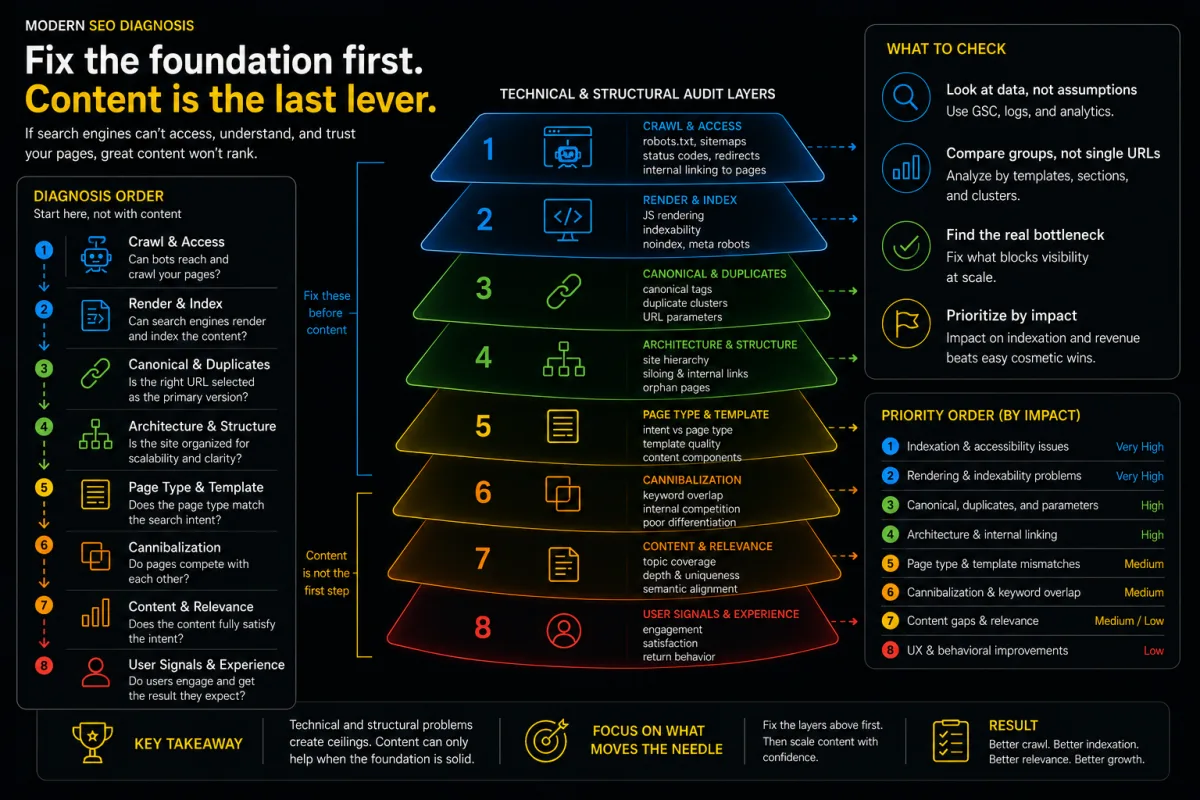
ChatGPT ads create a landing page problem before they create a media buying problem.
The first question is not "what bid should we set?" or "how do we hack visibility in ChatGPT?" The useful question is simpler: if a user reaches this page from a conversational ad context, will the page answer the task clearly, load reliably, track correctly, and stay within policy?
OpenAI now has public advertiser documentation for Ads in ChatGPT, Ads Manager, measurement, JavaScript Pixel, Conversions API, supported events, ad policies, and OAI-AdsBot. That does not mean every brand should rush into a campaign. It means PPC and SEO teams need a readiness workflow that treats the landing page as part of the system.
A ChatGPT ad click can sit closer to an assisted decision than a classic keyword click. The user may be comparing options, asking for a recommendation, checking a product category, or trying to solve a business problem. A weak landing page with generic claims, slow templates, broken tracking, blocked validators, thin product information, or unclear offer logic will not become strong because the traffic source is new.
What Changed
OpenAI's advertiser documentation now gives marketers a clearer implementation path: create ads, use landing pages, configure campaign settings, and measure events with supported tools. OpenAI also documents OAI-AdsBot as a crawler used for ad-related purposes, and its ads policies define prohibited, restricted, and controlled categories.
This turns ChatGPT ads from a vague future channel into an operational checklist.
The workflow now touches several teams: PPC decides campaign structure, budgets, targeting context, and reporting; SEO checks content substance, crawlability, page structure, indexability, and internal linking; developers implement pixels, Conversions API events, consent behavior, redirects, and performance fixes; security or infrastructure teams review crawler access, WAF rules, and protected routes; legal or founders review claims, testimonials, pricing, guarantees, and sensitive categories.
If those teams work separately, the page can pass one checklist and fail another. A page can be persuasive but impossible to measure. It can track events but violate policy. It can be crawlable by Google but blocked for ad validation. It can look polished but fail to explain the offer.
What Landing Page Readiness Actually Means
Landing page readiness is not a design preference. It is a set of operational conditions.
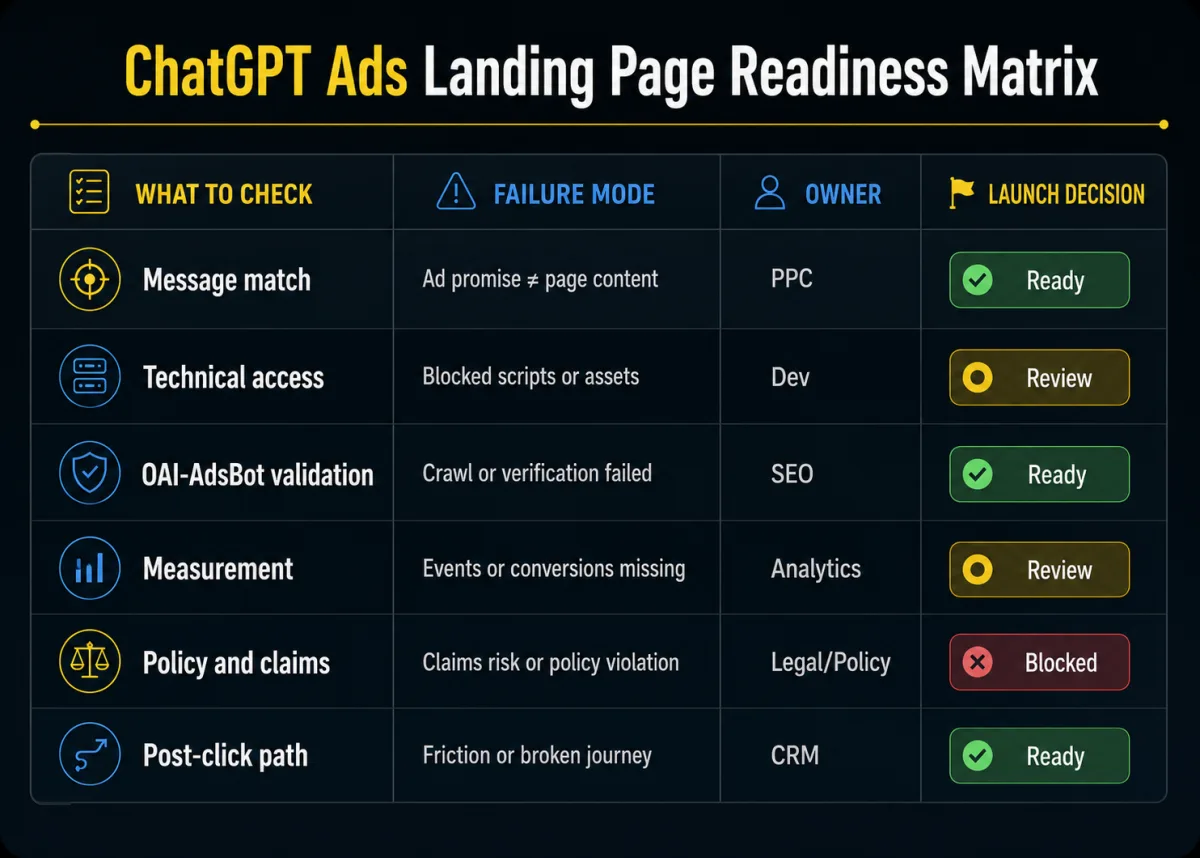
A ready page should have a clear offer that matches the ad context, visible information that answers the user's likely task, stable URLs without unnecessary redirect chains, accessible content without broken scripts or blocked resources, mobile performance good enough for paid traffic, measurement events mapped before launch, policy-sensitive claims reviewed by a human, crawler and validator access configured deliberately, a checkout or lead path that works, and privacy, terms, pricing, refund, or availability details where relevant.
This overlaps with Google Ads principles because landing page experience, destination quality, relevance, and usability still matter. But ChatGPT ads add a new framing: the landing page may need to resolve a conversational comparison, not just a keyword promise.
A normal PPC page says: "Book a technical SEO audit." A stronger AI-context page answers: "What kind of audit is this, who is it for, what evidence will we inspect, what access do we need, what is excluded, how long does it take, and what does the client receive?"
The ChatGPT Ads Landing Page Workflow
1. Map conversation intent to the landing page job
Start by writing the user's likely question before writing the ad.
Examples: Which SEO agency can help us prepare for AI search without rebuilding the whole site? How do we audit product pages for ChatGPT shopping and Google Merchant Center? Can someone fix our technical SEO before a migration? What is the safest way to automate SEO reporting without giving an agent production access?
Each question implies a different landing page job. A page for AI Search/GEO should explain source readiness, crawler access, entity clarity, evidence blocks, and measurement limits. A page for PPC should explain campaign structure, landing page QA, tracking, and budget controls. A page for ecommerce should explain feed, product schema, variants, images, checkout, and availability.
Do not send all ChatGPT ad traffic to a generic homepage unless the campaign goal is brand discovery. A conversational ad click usually needs a focused answer.
2. Build message match before media setup
Before launching the campaign, create a message match table: ad promise, landing page H1, first screen, proof, CTA, exclusions, and risk claims.
This prevents the common PPC mistake of building ads faster than pages. If the ad says "AI Search audit," but the page only says "grow your traffic," the system may still deliver visitors, but the user has to do too much interpretation.
For Lemon SEO, the page should sound founder-led and technical: practical workflow, constraints, evidence, and decisions. Avoid generic phrases that could fit any agency.
3. Make the page readable to users, crawlers, and validators
A landing page must be inspectable. Check that the main offer is in HTML, not only inside an image; headings describe the page structure; the CTA is visible without blocking content; pricing, availability, region, or scope details are not hidden in scripts; forms work on mobile and desktop; important JavaScript resources are not blocked; images have useful alt text; redirects are intentional and short; the final URL matches the submitted landing page; privacy and contact information are easy to reach.
This is technical SEO applied to paid traffic. The page should not depend on a perfect browser session to communicate the offer.
4. Handle OAI-AdsBot and crawler access deliberately
OpenAI documents OAI-AdsBot for ad-related crawling. That does not mean you should open the whole website.
Create an access policy for ad landing pages: allow OAI-AdsBot on submitted ad landing pages; keep account, checkout, admin, preview, and staging areas protected; avoid blocking landing pages with WAF bot scoring by accident; confirm robots.txt does not contradict the campaign goal; test redirects, canonicals, and status codes; log requests by user agent, path group, status, and edge decision.
This should connect to the broader AI bot access policy. OAI-SearchBot, GPTBot, ChatGPT-User, and OAI-AdsBot do not have the same purpose.
5. Implement measurement without polluting analytics
OpenAI's ads documentation covers JavaScript Pixel, Conversions API, and supported events. The implementation decision should be made before launch, not after the first week of spend.
A practical event plan includes landing page view, CTA click, form start, form submit, booking completed, purchase, and checkout error. Use UTM parameters consistently, but do not rely only on front-end analytics. Browser restrictions, consent behavior, redirects, and form tools can break attribution. For higher-value lead gen or ecommerce, server-side events through Conversions API may be more reliable, but they require careful engineering and privacy review.
Do not invent metrics like "ChatGPT ad quality score" unless the platform actually exposes them. Report what can be measured: spend, clicks, CTR, CPC/CPM where available, conversions, lead quality, landing page conversion rate, crawl access, and policy issues.
6. Review policy, claims, and sensitive categories
AI ad surfaces are sensitive because ads appear inside a conversational product. That increases the cost of misleading claims.
Review ranking guarantees, AI visibility guarantees, revenue guarantees, medical, financial, legal, employment, housing, or other sensitive claims, testimonials, before/after claims, availability, pricing, urgency, scarcity language, and competitor comparisons.
For Lemon SEO, the safest framing is practical and bounded. Say what the process includes. Say what evidence will be reviewed. Say what requires human approval. Avoid promising rankings, AI citations, traffic, or revenue.
7. Test the full path before spend
Before launching, run a release-style QA pass: final URL status code, mobile layout, page speed, form submission, calendar booking, payment or checkout if relevant, tracking events, server-side event receipt, consent behavior, thank-you page, CRM integration, email notification, blocked crawler logs, policy-sensitive copy, internal links, image loading, and accessibility basics.
Then write the launch note in plain language: campaign URL, OAI-AdsBot access policy, protected routes, tracking implementation, claim review, and approval owner.
Example: A 10-Day Launch Readiness Sprint
Day 1: define campaign intent and landing page job. Day 2: audit the current landing page. Day 3: rewrite page structure. Day 4: technical SEO QA. Day 5: crawler and infrastructure review. Day 6: measurement implementation. Day 7: policy and claim review. Day 8: end-to-end test. Day 9: launch readiness review. Day 10: controlled launch.
The output is not a vague "AI ads strategy." It is a tested landing page system: clear message, crawlable content, safe crawler access, reliable measurement, policy-reviewed claims, and a human-readable launch note.
Risks and When Not to Launch Yet
Do not launch ChatGPT ads if the landing page makes unsupported ranking, AI citation, revenue, or timing promises; the form or checkout path is unreliable; tracking is not implemented or cannot be interpreted; the page is blocked by WAF, robots.txt, redirects, or JavaScript rendering issues; pricing, availability, or scope is unclear; legal or founder review has not happened for sensitive claims; the team expects the new ad channel to fix a weak offer; sales cannot identify the source and quality of leads.
Also avoid treating ChatGPT ads as a replacement for SEO. Paid visibility can test demand and offers, but it does not build the long-term content, authority, internal linking, technical foundations, and source credibility needed for organic search or AI Search/GEO.
The Bottom Line
ChatGPT ads should be treated as a new paid channel with old operational discipline.
The landing page still has to explain the offer, load quickly, match the ad promise, respect policy, track correctly, and protect private areas. The new layer is conversational intent: users may arrive after asking an assistant for help, comparison, or recommendation, so the page needs to answer the real decision, not just repeat a keyword.
For Lemon SEO clients, the work sits between PPC, technical SEO, AI Search/GEO, SEO-first web development, and marketing automation. The right deliverable is not a vague "AI ads strategy." It is a tested landing page system: clear message, crawlable content, safe crawler access, reliable measurement, policy-reviewed claims, and a human-readable launch note.
For cross-channel landing page and marketplace context, review the B2B Amazon and Google synergy case before adapting the workflow to paid traffic. Read the related case context.
Continue with ChatGPT agent allowlisting, product data readiness, and PPC landing page work.