
A share button needs a search policy. Before a user-created page goes live, decide whether it belongs in public search, should work only through a direct link, or requires restricted access. Treat that decision as part of the product specification, with an owner and an observable release check.
Google's October 26, 2026 documentation update added guidance on link-shared content and abuse monitoring to its user-generated spam guide. This is a documentation change, not an announcement of a new ranking system. Google's update record provides the dated starting point for this audit.
Below is our proposed workflow for teams operating collaboration tools, generated reports or other user-created pages. The example is fictional. It illustrates decisions and checks, without claiming client results or predicting traffic gains.

Separate link access from search discovery
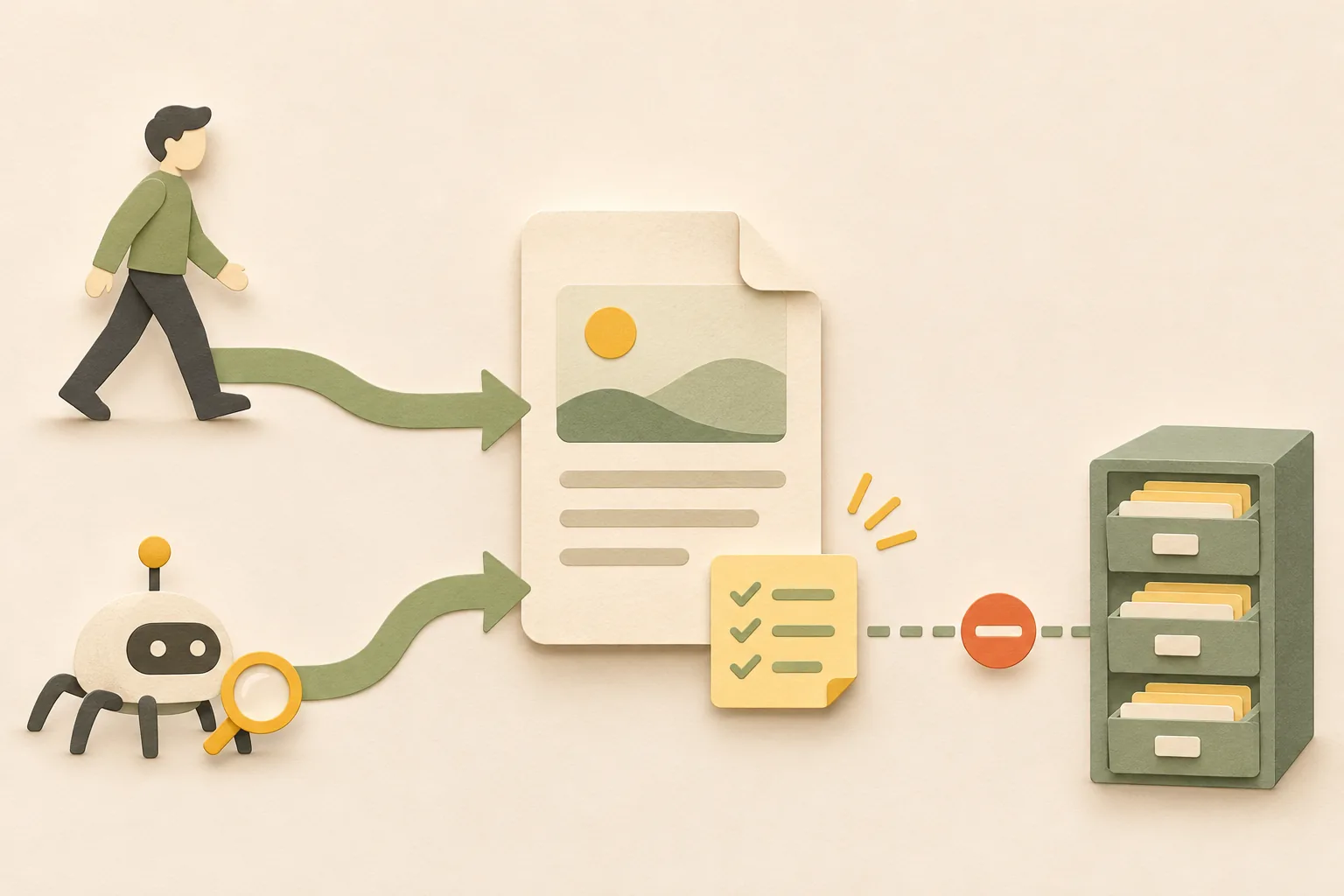
The illustration separates two routes to the same public page: a person following a link and a crawler evaluating it for search. The checkpoint represents an indexing instruction, not a login barrier. Use this distinction when someone asks for a page to be “unlisted”: write down which audience should still be able to open it.
Google's UGC guidance asks whether shareable outputs are intended for search discovery or direct access. It suggests default controls for pages intended for sharing, collaboration or utility. Source: intended audience.
For a public link-only page, noindex can prevent Google Search inclusion while people continue to visit the URL. Private material needs access protection instead: Google's sharing guidance recommends password protection for confidential content. Source: access and visibility.
Choose controls for the page's purpose
The UGC guide mentions both noindex and blocking crawling. Those controls have different jobs. Google's robots documentation says robots.txt manages crawler access and is not a mechanism for keeping a web page out of Google. Source: robots.txt limits.
When relying on noindex, let Googlebot fetch the page and read the rule. Blocking the URL in robots.txt can prevent that reading; the URL may still appear in search. Source: crawl access requirement.
Google supports noindex through an HTML robots meta tag or an HTTP response header; putting the rule in robots.txt is unsupported. The header can also apply to non-HTML resources, including PDFs. Implementation methods and header scope.
Make these proposed risk checks explicit in the change request:
- Wrong objective: a private workspace is being given only a search-exclusion rule. Return the request to the access-control owner.
- Conflicting instructions: a crawler is denied access to a page whose
noindexit needs to read. Resolve the intended behavior before rollout. - Overbroad scope: the proposed default covers approved public tutorials as well as shared outputs. Split the route groups and review both.
- Unowned exceptions: someone can make a page searchable without a recorded decision. Assign an owner and a review step for that action.
Use the technical SEO audit checklist as a broader planning reference, while keeping this change focused on the affected page family.
Work through a shared-page policy example
| Page purpose | Proposed control | Release check |
|---|---|---|
| Private client workspace | Require authentication and authorization | Unauthenticated visitor cannot read the content |
| Public link-only calculator result | Serve noindex while allowing crawler access | Response exposes the indexing instruction; direct sharing still works |
| Approved public tutorial | Review before permitting search discovery | No accidental exclusion rule; moderation decision recorded |
The comparison shows our proposed policy for a fictional collaboration product with private workspaces, public calculator results and approved tutorials. Each row pairs a user purpose with a control and a release check. It is a decision aid, not an account screenshot or a record of a completed implementation.
For a calculator result that should work by direct link but stay out of search, start with the second row. Ask the owner to confirm that the output contains no material requiring restricted access.
For this example, we would record three acceptance scenarios:
- Private workspace: an authorized member can use it; a visitor without authorization cannot read its contents. Record the access outcome separately from search checks.
- Public shared result: the direct link works for its intended audience, and a crawlable response carries
noindex. Record the actual response evidence. - Approved tutorial: the owner has approved public discovery, and the page has no accidental exclusion instruction. This check does not promise that Google will index or rank it.
Use non-sensitive test content. Record expected outcomes before testing.
Run a bounded audit before changing defaults
Our suggested first pass is one route family, one responsible product owner and one engineering owner. A useful deliverable is a short inventory with the route pattern, page purpose, current setting, proposed setting and evidence needed to accept the change.
- List the entry points. Include creation, duplication, sharing and any publish action in the test plan. Ask the owner which actions may change the page's intended audience.
- Classify the URLs. Assign each sample to private, public link-only or intended for public search. Put unresolved samples aside for an owner decision rather than applying a guessed default.
- Capture the baseline. Save the current response status, relevant headers and HTML for the authorized test URLs. Record the date and the test account's access level without recording credentials.
- Specify the change. Write the intended rule at the template or response layer, identify the exact routes affected and name the owner who can restore the previous behavior.
- Test opposing cases. Check a page that should be excluded and a public page that should remain eligible. Also test the private-access scenario separately. A passing exclusion test alone is insufficient to approve the whole change.
- Review before release. Compare the observed responses with the written acceptance scenarios. Resolve exceptions, then ask the responsible owner to authorize the bounded rollout.
- Recheck after release. Verify the same samples against the deployed behavior. Keep application checks and subsequent Search Console observations as separate evidence.
Include generated downloads explicitly in the scope or assign them a separate review.
Google recommends URL Inspection to examine the HTML Googlebot received and the Page Indexing report to monitor extracted noindex rules. Google must crawl the page to see the rule, and revisits can take time. Source: verification and timing. A successful local response test should therefore be reported as implementation evidence, not completed removal from search.
Stop rollout if a private test page remains readable without authorization, a required rule is absent, or an intended public page is excluded. Preserve the response and name the failed scenario.
Monitor the policy after release
Google's abuse guide recommends checking Search Console for unexpected indexed-page growth, impressions and irrelevant queries, alongside platform creation and indexing signals. It also recommends monitoring whether a few users produce a large share of indexable URLs. Source: abuse monitoring.
The same guide suggests noindex for content from new users without reputation and nofollow or ugc on links in untrusted content. These are distinct recommendations for pages and links. Source: untrusted content.
Our proposed operating routine is deliberately small:
- Review a saved set of representative URLs after each relevant template or sharing-setting change.
- Compare unexpected growth with the product's own release and publishing records before deciding it is abuse.
- Assign suspicious patterns to a human reviewer, with the affected route family and supporting examples.
- Keep a record of approved exceptions and the person responsible for revisiting them.
Choose thresholds from actual usage and review capacity. This workflow proposes no universal ratio or guaranteed result.
Decide who owns the next change
If you need help defining search treatment and acceptance checks, explore our SEO services. Route and response implementation can be scoped with Web development services, while recurring checks can be discussed through Marketing automation services. Keep responsibility for private access with the product's access-control owner.
Bring a representative URL family, the intended audience and current visibility settings when you Request a free audit.