
Google's May 2026 shopping and ads announcements made one thing harder to ignore: ecommerce growth now depends on how consistently a product is described across every commercial system, not only on the visible product page.
AI-assisted shopping does not remove the need for traditional ecommerce SEO. It compresses the distance between the product page, Merchant Center feed, structured data, product imagery, policy information, checkout facts, and ad systems.
That means the ecommerce SEO job becomes more operational. You are not just optimizing a title tag. You are making sure the same product facts can be trusted by search engines, shopping surfaces, ad systems, answer experiences, and humans trying to buy.
The practical question is not "how do we rank in AI?" It is simpler and more useful: can every system that touches the product agree on what the product is, whether it is available, what it costs, how it ships, and why the buyer should trust it?
What changed in May 2026 shopping discovery
At Google Marketing Live 2026, Google announced several commerce and ads changes that point in the same direction: product data is becoming a stronger input for conversational search, paid discovery, and AI-assisted shopping journeys.
The important themes for SEO and PPC teams are:
- Shopping ads can be matched to more conversational and exploratory queries, using signals from the product feed and product context.
- Merchant Center data, landing page content, creative assets, pricing, availability, and policies need to tell the same story.
- Agentic and AI-assisted checkout experiences increase the cost of inconsistent product, shipping, return, or stock information.
- Merchant Center and campaign diagnostics are becoming more connected to product content quality, not only bidding and budget.
Some features roll out by market, account type, and eligibility. But the direction is already clear enough for planning: ecommerce teams need stronger product data governance before they scale AI Search, Shopping ads, Performance Max, Demand Gen, or marketplace-style discovery.

Why product data readiness matters
A product is not a single page. It is a bundle of facts that appears in many places: the product detail page, collection page, Merchant Center feed, structured data, image files, variant selector, stock system, checkout, shipping page, returns page, paid campaign, organic result, and AI-assisted answer.
If those facts diverge, the problem is not cosmetic. It can affect eligibility, diagnostics, user trust, conversion rate, rich result quality, ad matching, and the confidence of systems that summarize or recommend products.
The facts that most often need governance are:
- product title, brand, model, category, and variant naming;
- GTIN, MPN, SKU, size, color, material, compatibility, and other attributes;
- price, sale price, currency, tax display, and final checkout price;
- availability, preorder status, backorder rules, and stock visibility;
- main image, variant images, crawlable media URLs, and image accessibility;
- shipping price, delivery time, return window, and policy URL;
- review, rating, and offer markup where it is valid and visible.
When these facts match, SEO and PPC teams can work from the same truth. When they do not, every channel starts debugging its own symptom.
Product Data Consistency Map
The same commercial facts should be validated across the five systems that search, ads, and buyers rely on.
-
Landing Page
H1, description, price, availability, canonical URL.
-
Merchant Feed
Title, GTIN or MPN, image link, shipping, returns.
-
Structured Data
Product, Offer, price, availability, image, brand.
-
Images And Media
Main image, variant images, crawl access, alt text.
-
Checkout And Policies
Final price, delivery, returns, stock status.
The Product Data Readiness Workflow
1. Define the source of truth for commercial facts
Before auditing pages or feeds, decide where each product fact should be owned. The product information management system may own titles, attributes, and identifiers. Ecommerce operations may own price, tax, and stock. UX or legal may own return policy language. SEO may own crawlability, internal linking, and structured data validation.
The point is not to create a huge governance document. The point is to stop a feed specialist, developer, merchandiser, and SEO from fixing the same mismatch in four different places.
For each product category, define:
- required identifiers and category-specific attributes;
- where title and description templates are generated;
- how variants should appear on the page and in the feed;
- which source controls price, availability, and shipping;
- who approves policy text and checkout-facing promises;
- how changes are validated after release.
2. Check feed, structured data, and landing page consistency
The most useful review is a row-by-row comparison. Pick a representative product set: best sellers, high-margin products, paid traffic products, seasonal products, out-of-stock products, variants, discounted products, and products with complex shipping or return rules.
Then compare the landing page, Merchant Center feed, structured data, and checkout for each field. Do not only check whether markup validates. Check whether the markup describes what the buyer can actually see and buy.
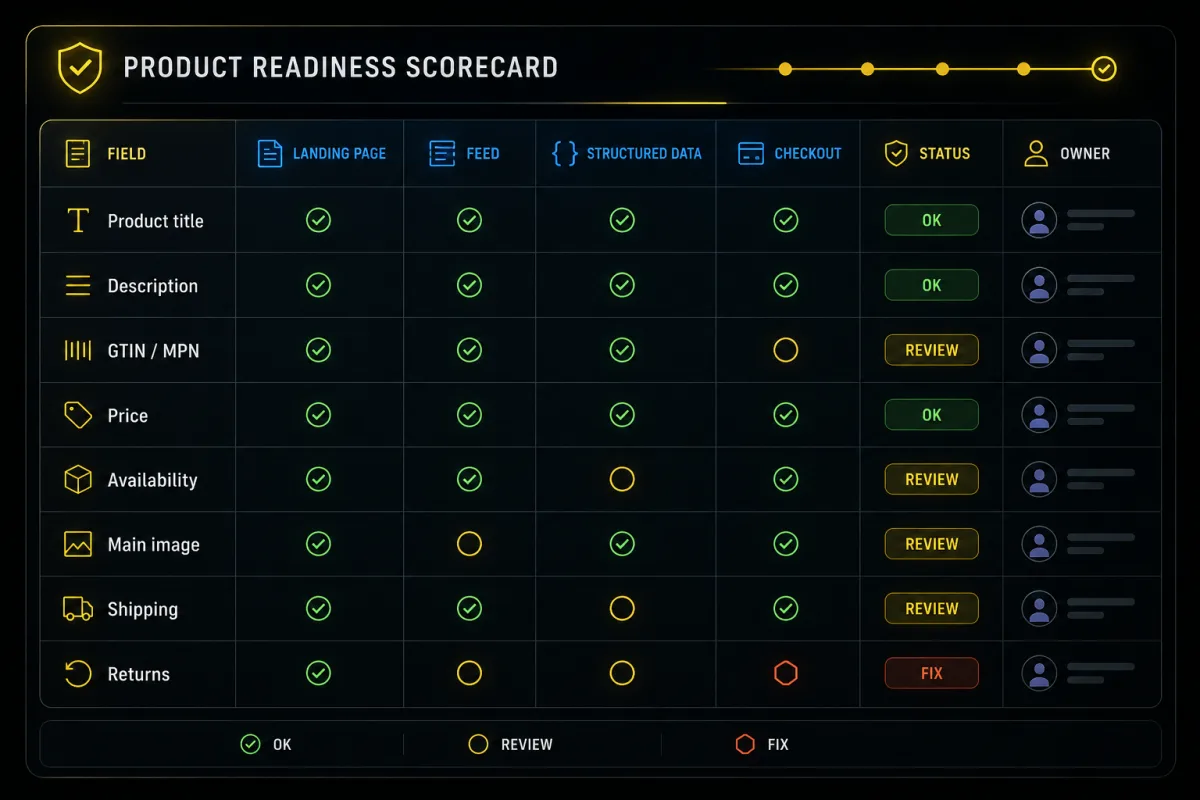
| Field | Landing Page | Feed | Structured Data | Checkout | Status | Owner |
|---|---|---|---|---|---|---|
| Product title | Match | Match | Match | N/A | OK | SEO |
| Description | Needs update | Match | Missing | N/A | Review | Content |
| GTIN / MPN | Missing | Present | Missing | N/A | Fix | Ecommerce |
| Price | Match | Match | Match | Match | OK | Ops |
| Availability | In stock | In stock | Out of stock | In stock | Fix | Dev |
| Shipping | Visible | Present | N/A | Match | OK | Ops |
| Returns | Hidden | Present | N/A | Match | Review | UX |
3. Validate product images and media access
Product imagery is no longer only a conversion asset. It is also a discovery asset. Feeds, product pages, image search, merchant surfaces, and AI-assisted shopping systems all rely on media being accessible, accurate, and matched to the correct variant.
Check that:
- the main image in the feed matches the visible primary image or a deliberate high-quality commerce image;
- variant images are mapped to the correct color, size, material, or bundle;
- image URLs are crawlable and not blocked by robots rules, hotlink protection, or expiring parameters;
- image dimensions and compression are suitable for both page speed and visual quality;
- alt text describes the visible product and does not stuff keywords;
- generated or edited imagery does not misrepresent the product.
4. Validate checkout, shipping, returns, and policy promises
Product data readiness is not finished at the product page. A shopper may see one price in a result, another price on the product page, and a third price at checkout after tax, delivery, coupons, or bundle logic. Some differences are legitimate. Unexplained differences are trust leaks.
For each reviewed product, compare:
- displayed product price vs feed price vs structured data price vs checkout price;
- availability on the page vs stock status in checkout;
- shipping promise on the product page vs delivery estimate in checkout;
- return policy text on the page vs policy URL and checkout wording;
- sale pricing, bundles, subscriptions, and regional price rules.
This is where PPC, ecommerce operations, SEO, and UX need the same QA process. A mismatch may look like an SEO issue in Search Console, a disapproval in Merchant Center, or a conversion-rate issue in analytics. The root cause is often the same data problem.
5. Build a monitoring loop, not a one-time cleanup
Product data changes constantly. Prices change, products go out of stock, variants are added, shipping rules update, policies change, and templates get refactored. A one-off audit helps, but a recurring loop catches regressions.
A practical monthly workflow:
- Export a priority product set from the ecommerce platform or feed.
- Crawl product URLs and collect rendered product facts.
- Validate Product and Offer structured data.
- Compare feed fields against visible page content.
- Spot-check checkout price, availability, delivery, and return promises.
- Review Merchant Center diagnostics and ad disapprovals.
- Turn mismatches into owner-specific tickets.
- Re-test fixed templates before closing the issue.
This is a natural fit for marketing automation and technical SEO reporting. The goal is not to create more dashboards. The goal is to detect mismatches while they are still small.
Common failure patterns
Most product data problems are not dramatic. They are boring in exactly the way expensive operational problems tend to be boring.
- Variant mismatch: the page shows one selected variant, but the feed or structured data describes another.
- Sale price drift: sale price is visible on the page but the feed, schema, or checkout still uses the regular price.
- Stock disagreement: product page says "in stock" while structured data or checkout says unavailable.
- Identifier gaps: GTIN, MPN, brand, or category fields are missing from one system but present in another.
- Image access issues: feed image URLs work for users but fail for crawlers or expire after a short time.
- Policy ambiguity: return and shipping promises are visible somewhere on the site but not attached clearly to the product or checkout path.
- JavaScript-only facts: critical price, availability, or variant information appears only after client-side rendering and is not reliably available to crawlers.
- Over-optimized titles: page titles, feed titles, and ad assets diverge because each team optimized for its own surface instead of a shared product identity.
Each issue is fixable. The harder part is building a process that prevents the same mismatch from returning in the next release.
Measurement and ownership
Product data readiness should be measured as an operational quality layer, not only as an SEO ranking project.
Useful metrics include:
- percentage of priority products with matching page, feed, schema, and checkout facts;
- count of products missing required identifiers or category-specific attributes;
- Merchant Center diagnostics by issue type and owner;
- structured data validation issues by template;
- number of price, availability, shipping, and return mismatches found in QA;
- paid traffic spend attached to products with unresolved data issues;
- conversion impact after high-priority mismatches are fixed.
The ownership model matters as much as the metrics. SEO can identify crawl and structured data problems, but SEO cannot own every product fact. PPC can see performance waste, but PPC cannot fix checkout logic alone. Developers can repair templates, but they need acceptance criteria that specify which product facts must match.
The best operating model has one shared scorecard and clear owners. It should say what is wrong, where it appears, how many products are affected, which team owns the source of truth, and how the fix will be validated.
The bottom line
The May 2026 shopping updates are not a reason to chase a new shortcut. They are a reason to tighten the product data layer that already supports ecommerce SEO, shopping ads, AI-assisted discovery, and conversion.
For ecommerce teams, product data readiness means:
- clean product facts on the landing page;
- accurate and complete feed attributes;
- structured data that matches visible content;
- crawlable images and media;
- checkout and policies that confirm the same commercial promise;
- SEO, PPC, ecommerce, content, UX, and development teams working from one validation workflow.
That is the practical foundation for AI Search and Shopping ads. When product data is consistent, the site gives search systems, ad systems, and buyers fewer reasons to hesitate.
For related Lemon SEO workflows, read SEO Tools + MCP for Claude Code and Codex, Technical SEO Audit Checklist, and our AI Search service page.