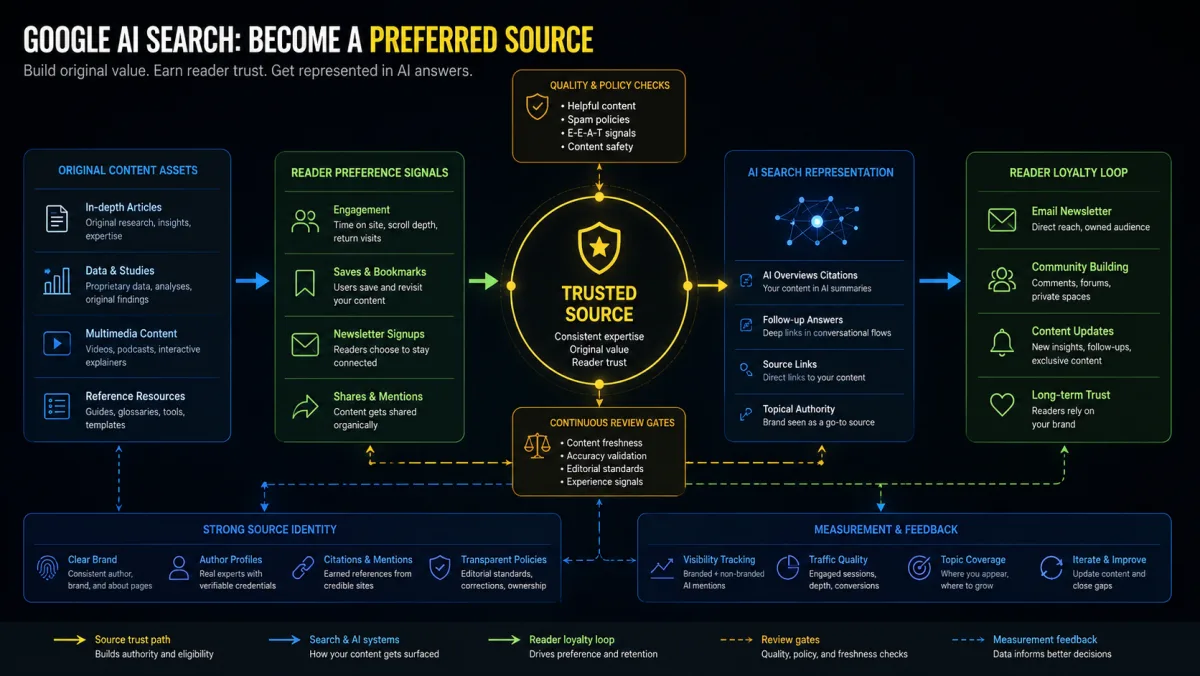
Google's Preferred Sources update is easy to misunderstand. It looks like a shortcut for AI Search visibility, but the better lesson is source identity, reader trust, and original content architecture.
On May 27, 2026, Google announced that Preferred Sources are coming to AI Overviews and AI Mode. If a user has selected a website as a preferred source, links from that site can be highlighted in AI responses with a "Preferred" label.
Google also announced more prominent carousels for timely articles and broader use of "Highly Cited" labels to help users identify influential original coverage.
That sounds like an AI Search shortcut. It is not.
Preferred Sources is not a ranking button. It does not mean a site can force itself into AI Mode. It does not replace technical SEO, original reporting, useful content, clear titles, or brand trust.
The practical lesson is better: Google is making user preference and source recognition more visible inside AI Search experiences. That means publishers, expert blogs, and founder-led brands need to think beyond one-off search visits. They need to become a source people remember, trust, and intentionally choose.
What Google Announced
Google's announcement includes three important pieces.
First, Preferred Sources are expanding into AI Overviews and AI Mode. Google's documentation says users can select domain-level or subdomain-level sites as preferred sources, and those sites may be highlighted for users who selected them.
Second, Google is adding more ways to explore timely articles and perspectives. For some searches around developing topics, users may see a prominent carousel with articles and viewpoints.
Third, Google is expanding "Highly Cited" labels for web article links. Google describes this as a way to help users spot original or influential coverage that other stories reference.
For SEO teams, these are not isolated UI details. They point to a broader direction: source identity matters more when search becomes conversational, synthesized, and personalized.
What Preferred Sources Does Not Mean
Before building a workflow, remove the wrong assumptions.
Preferred Sources does not mean every site should add a button and wait for AI Search traffic.
It does not mean a user's selection guarantees visibility for every query.
It does not mean Google is asking publishers to create thin "AI answer" pages.
It does not mean "Highly Cited" can be manufactured through low-quality link campaigns.
It does not mean a service business should pretend to be a newsroom.
The feature is more useful when treated as an audience and content architecture opportunity. If people already value your site, Google is giving them another way to express that preference. If people do not know or trust your site, a Preferred Sources CTA will not fix the underlying problem.
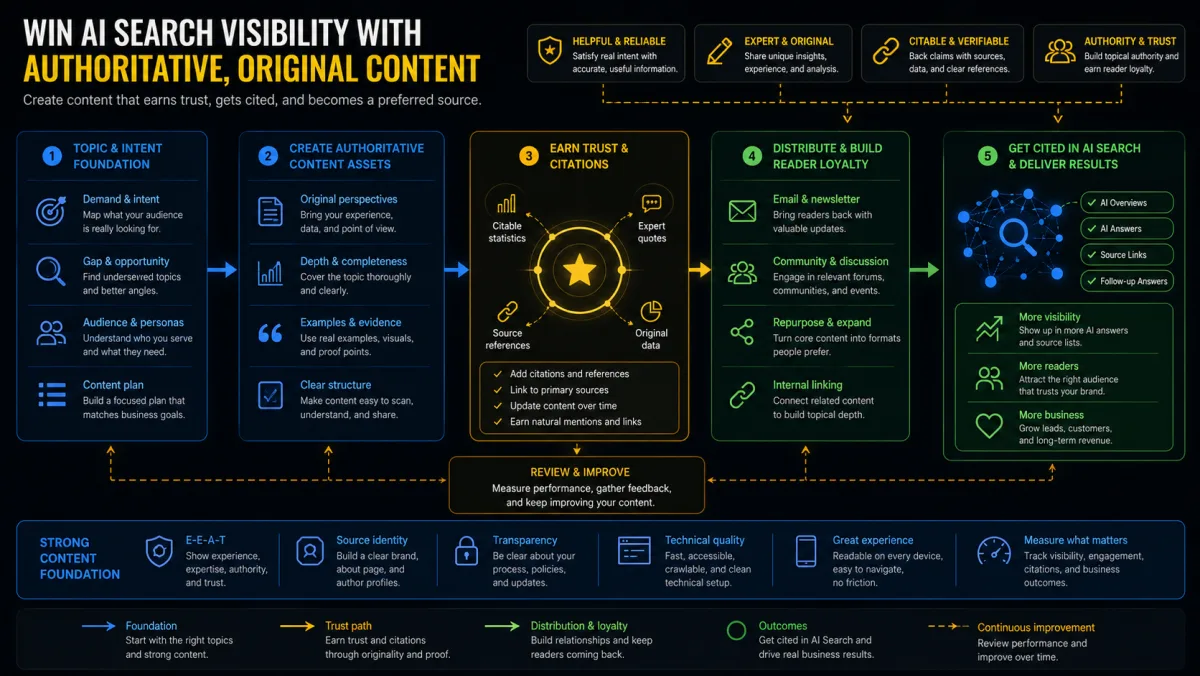
The Preferred Sources SEO Workflow
1. Define what your site deserves to be preferred for
Start with positioning.
A site cannot be meaningfully "preferred" for everything. A strong source has a recognizable lane.
For a technical SEO agency, the lane might be:
- AI Search and GEO workflows without fake metrics;
- technical SEO audits and release QA;
- MCP and SEO automation;
- Google Business Profile and local SEO for service businesses;
- ecommerce product data and Amazon / Google Ads crossover;
- SEO-first web development.
For an ecommerce publisher, the lane might be product comparisons, durability testing, buying guides, or category expertise.
For a local business, the lane might be practical local guides, neighborhood expertise, and service-specific answers.
Write a source identity statement:
We want readers to prefer us for practical, evidence-based technical SEO and AI Search workflows that help founders and operators make better decisions.
That statement becomes a filter. If an article does not reinforce the source identity, it may not belong in the preferred-source strategy.
2. Build original content assets, not generic posts
Preferred Sources rewards a relationship with readers. Generic posts do not build that relationship.
Audit your content into four buckets:
- original insight: methods, frameworks, audits, experiments, first-party experience;
- practical utility: checklists, workflows, templates, decision trees;
- explainers: useful definitions and context;
- commodity content: posts that repeat what many sites already say.
The priority is to increase the first two buckets.
A weak post says: "AI Search is changing SEO."
A stronger asset says: "Here is a source-readiness audit for ChatGPT Search and Google AI Mode, including crawler access, citation structure, evidence blocks, and measurement limits."
The second version is easier to remember. It gives readers a reason to return. It also gives them a reason to select the site as a preferred source.
3. Make the site easy to recognize and select
Google's Preferred Sources documentation says domain-level and subdomain-level sites are eligible, while subdirectories are not eligible as separate preferred sources.
That matters for brand architecture.
If your best content lives under example.com/blog, users are selecting example.com, not the blog folder. If your publication lives on insights.example.com, that subdomain can be its own source. This is not a reason to move content casually, but it is a reason to be deliberate.
Check:
- is the site name consistent?
- does the favicon work?
- are title links clear?
- do article titles reinforce the brand's area of expertise?
- do meta descriptions explain why the article is useful?
- does the author or publisher context appear consistently?
- do article pages include visible dates where freshness matters?
- do social profiles and newsletters use the same source identity?
Preferred Sources is partly a user behavior feature. Users need to recognize the site before they can choose it.
4. Add Preferred Sources CTAs carefully
Google's documentation gives site owners ways to guide readers toward selecting a site as a preferred source, including a deeplink format:
https://google.com/preferences/source?q=example.comA CTA can be useful, but it should not be spammy.
Good places to test it:
- newsletter footer;
- article end section;
- author bio block;
- social posts promoting original research;
- recurring roundup pages;
- resource hubs;
- subscriber welcome emails.
Avoid adding a loud CTA above every article. That can feel desperate and may distract from the actual content.
A better article-end CTA:
If our technical SEO and AI Search workflows are useful, you can add Lemon SEO as a Preferred Source in Google Search.
The CTA should be secondary. The primary job of the page is still to be useful.
If Lemon SEO's technical SEO and AI Search workflows are useful, you can add Lemon SEO as a Preferred Source in Google Search.
5. Strengthen article-level trust signals
Preferred Sources is site-level, but trust is built page by page.
For important articles, check:
- clear H1;
- title that matches the article's real value;
- concise intro that says what the reader will get;
- visible author or publisher context;
- date and update date where relevant;
- source table for factual claims;
- original examples;
- practical workflow or checklist;
- clear distinction between facts and recommendations;
- internal links to related service or resource pages;
- no unsupported metrics;
- no disguised competitor rewrite;
- no AI-generated filler.
For AI Search topics, this is especially important. There are too many vague claims about GEO, AI visibility, citations, and answer engines. A preferred-source strategy should make the brand more careful, not more confident without evidence.
6. Connect newsletter, social, and community loops
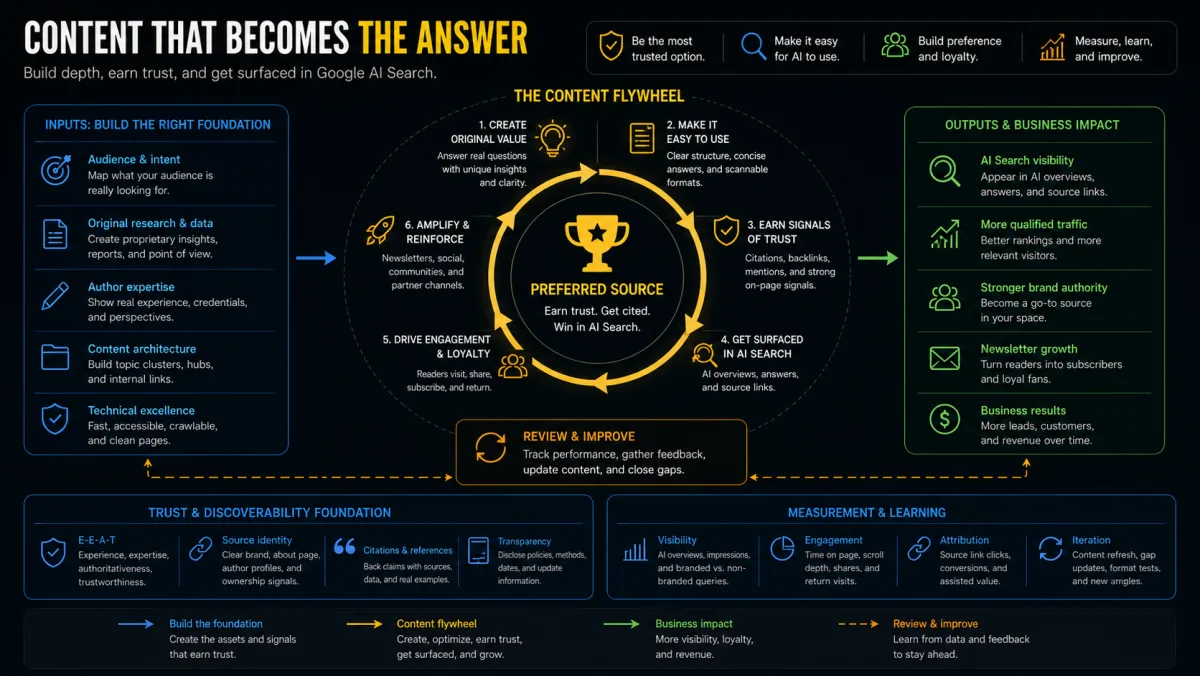
Preferred Sources is not only an SEO feature. It is also a loyalty loop.
A reader who finds one useful article may forget the site. A reader who subscribes, follows, bookmarks, or repeatedly clicks useful resources is more likely to remember the source.
Connect the content system:
- publish useful articles;
- summarize them in a newsletter;
- share one practical diagram or checklist on social;
- link back to the full article;
- invite readers to save or select the site as a source;
- update older resources when the topic changes;
- build topic hubs so readers can find related material.
This is where small expert brands can compete. They do not need to publish everything. They need to be unusually useful in a few recognizable areas.
7. Measure without inventing AI visibility metrics
Do not report "Preferred Sources rankings." That is not the right measurement.
Track what you can:
- Preferred Sources CTA clicks;
- newsletter subscriptions from article pages;
- returning visitors;
- branded search;
- direct traffic to resource hubs;
- Search Console clicks and impressions for article groups;
- social saves and shares;
- internal link engagement;
- citations or mentions from other websites;
- high-quality referral traffic;
- conversions assisted by article pages.
For Google AI Search specifically, be careful. If a user has selected your site as a preferred source, their experience can differ from another user's experience. Prompt screenshots are not a stable visibility report.
A better reporting line:
We added Preferred Sources CTAs to five original technical SEO resources and tracked CTA clicks, newsletter signups, returning visitors, branded queries, and Search Console performance for the resource group. We are not claiming AI Mode inclusion unless directly observed and documented.
That is boring in the right way. It is honest.
Example: A 30-Day Preferred Sources Readiness Sprint
Week 1: source identity and content audit.
Define what the site deserves to be preferred for. Audit existing articles into original insight, practical utility, explainers, and commodity content. Pick 5-10 pages that best represent the brand.
Week 2: article upgrades.
Improve the selected pages with stronger intros, source tables, dates, author/publisher context, original examples, diagrams, and internal links. Remove unsupported claims.
Week 3: CTA and loyalty loop.
Create a Preferred Sources CTA using Google's deeplink format. Add it to the article end section, newsletter footer, and selected social posts. Keep it secondary and respectful.
Week 4: measurement and review.
Track CTA clicks, newsletter signups, returning visitors, Search Console performance, branded queries, and article engagement. Document what changed and what remains unproven.
The output is not a guaranteed AI Search result. It is a stronger source system.
Risks and When Not to Do This
Do not add Preferred Sources CTAs to weak content. Upgrade the content first.
Do not imply that selecting the site guarantees visibility in AI Overviews or AI Mode.
Do not create fake originality. If the article only summarizes another source, cite it clearly and add your own useful framing.
Do not treat "Highly Cited" as a link-building trick. Influential coverage is earned through original value, not manufactured citation loops.
Do not split content onto subdomains only for Preferred Sources eligibility without considering SEO, analytics, brand, and migration risks.
Do not use intrusive popups asking people to select your site. That can damage trust.
The Bottom Line
Preferred Sources is not an SEO shortcut. It is a signal that source identity and audience loyalty are becoming more visible inside AI Search.
The practical move is to build a site worth preferring:
clear expertise, original assets, practical workflows, reliable sources, consistent branding, respectful CTAs, and honest measurement.
For founder-led expert brands, this is good news. You do not need to sound like everyone else. You need to become the source people want to hear from again.
How Lemon SEO Can Help
Lemon SEO helps founder-led teams build practical, evidence-based search systems: AI Search / GEO strategy, content architecture, technical SEO, and marketing automation.
A Preferred Sources strategy is not just a CTA. It is a content system: original assets, trust signals, internal links, update loops, measurement, and human review.
For related workflows, read What Is GEO?, AI Citation Signals, and SEO Tools + MCP for Claude Code and Codex.